
THE DATA CENTER EXPLAINER: WATER AND POWER
Data center water and power,
explained plainly
Will your power bill go up? What happens to our water? Get the local rules, the public commitments, and the important limits of what’s known.
MOVING HERE OR ALREADY HERE?
Get the lay of the land.
Local context for the whole region. Three mornings a week.
Free to read. Unsubscribe whenever you like.
START HERE
The short answers, before the detail.
BASE RATES THROUGH 2028
Frozen by PSC orderThe order freezes Georgia Power base rates; it does not guarantee every household’s total bill stays unchanged. Read the PSC fact sheet.
WHITE OAK POWER COSTS
County says Google paysColumbia County says Google will pay all project energy costs and ratepayers are protected from project infrastructure costs. The full agreement and campus demand are not in the public announcement. Read the county release.
COLUMBIA COUNTY WATER
No wells; county water serviceThe ordinance bars wells and limits sites to areas served by the county utility. Closed-loop cooling is a separate reported project commitment, not an ordinance requirement. Read the ordinance.
QTS WATER ESTIMATES
Not reconciled publiclyQTS estimates about 50,000 gallons a month per typical facility; Augusta Utilities’ director cited 18,000 gallons a day. The sources do not reconcile the figures. QTS estimate · city estimate.
Jump to a section
What the water and power questions actually measure
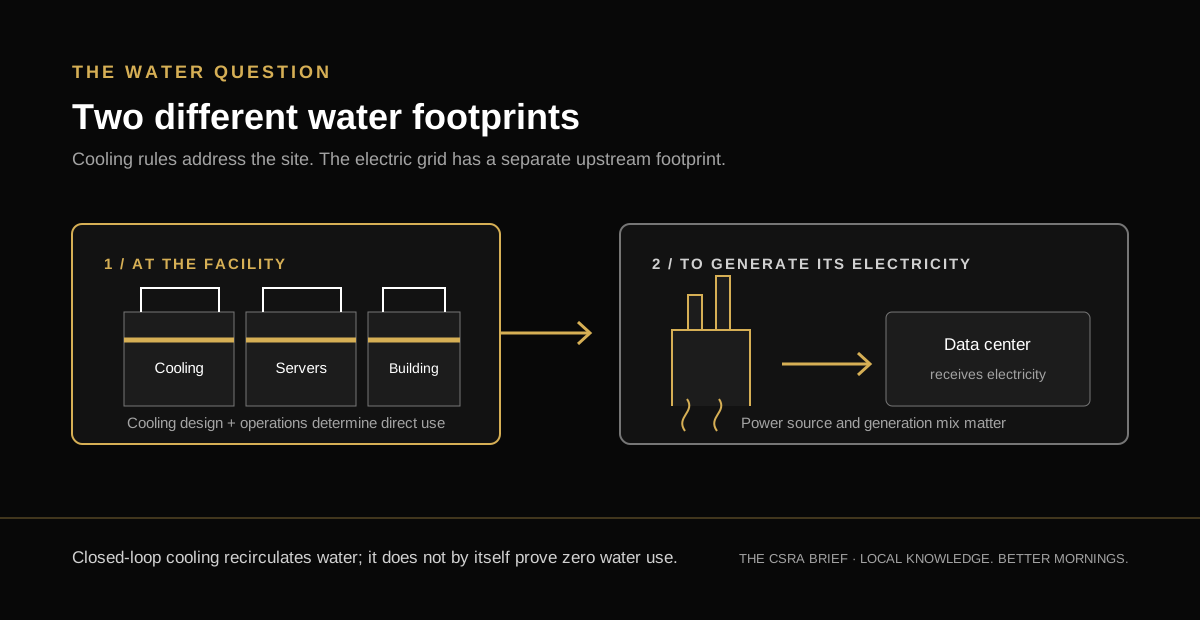
The diagram separates two different water questions:
- At the facility: water may be used for cooling, sanitation, or other operations. The amount depends on the cooling system and operating conditions.
- At the power source: generating electricity can also use water. That use happens at the power plant, not at the data center’s site.
“Closed loop” means cooling water circulates through a system instead of being used once and discharged. It does not automatically mean zero water use: a system may need make-up water, and the electricity supply has its own water footprint. A rule limiting wells or cooling technology is not the same thing as a public measurement of total water use.
Will my Georgia Power bill go up?
What is binding today
The Georgia PSC ordered a freeze on Georgia Power’s base rates through the end of 2028. Base rates are one part of a bill; a customer’s total amount can still vary with electricity use and other bill components. The PSC says it does not approve data-center construction, location, or operation.
Georgia Power says new customers using at least 100 megawatts, including data centers, pay for required infrastructure, sign long-term contracts, pay monthly minimums, provide collateral, and face termination charges. That is the utility’s description of its large-customer protections; the PSC’s orders and each project’s contracts determine the enforceable terms.
For White Oak specifically, Columbia County announced that Google committed to pay 100% of the project’s energy costs and that ratepayers would be protected from additional infrastructure, transmission, or capacity expenses. The county announcement is the public source for those commitments. It does not publish the campus’s expected megawatt demand or the full agreement, so readers cannot independently check the detailed cost allocation from that announcement alone.
What happens after 2028
Georgia Power projects residential savings after the freeze. Treat those figures as the company’s forecast, not a guaranteed bill reduction. Future rates and bills depend on later PSC decisions, actual demand, utility costs, and the terms of large-customer agreements.
Also keep the scope straight: the White Oak commitments apply to that project. They do not establish the bill impact or cost arrangements for every data center in Augusta, Aiken, or the wider CSRA.
What we can’t verify from public records linked here: White Oak’s actual expected power demand; the full terms of its power arrangements; and the eventual operating load of the regional projects. Avoid treating unsourced megawatt figures as confirmed.
WANT THE UPDATES WHEN THE RULES CHANGE?
Get the CSRA in your inbox.
Local news, useful numbers, and the follow-ups to this guide. Three mornings a week.
Free to read. Unsubscribe whenever you like.
What rules apply to water in Columbia County and Augusta?
The rules are local, and the projects are at different stages. Read the ordinance that applies to the site rather than assuming one area’s protections cover the whole region.
White Oak and other Columbia County sites
The county’s adopted ordinance, Section 90-147, says data-center developments may not use wells for any purpose and may locate only in areas served by Columbia County Water Utility. It also says upgrades required to county-owned utilities are the applicant’s responsibility.
Those are specific protections, but they do not mean the facility uses no water: county utility service can still supply water. The ordinance text does not itself require closed-loop cooling. Separately, WRDW reported that the planned Google facilities would use closed-loop systems. Treat that cooling description as a reported project commitment, distinct from the ordinance’s enforceable well and utility-service language.
Augusta and the QTS project
Augusta’s Commission approved a separate data-center ordinance on October 6, according to WRDW’s meeting report. The ordinance sets cooling and water-source rules for covered projects. The city’s ordinance page links the city’s approved text and supporting documents.
The large QTS project on Gordon Highway received zoning approvals before the moratorium and is not covered by the new zoning rules, according to WRDW. That makes it especially important to distinguish the new standards for future applications from what governs a project already approved.
QTS says its closed-loop cooling system will not consume water for cooling once operational. Its Augusta project page estimates about 50,000 gallons per month per typical facility for domestic use and humidification, plus a one-time initial fill of about 600,000 gallons per standard building. Those are company estimates; QTS says the final amount is still hard to predict.
There is a material gap in the public numbers: Augusta Utilities’ director told WRDW in May 2026 that the project was anticipating 18,000 gallons per day. The reporting and QTS page do not reconcile whether those figures cover the same buildings, uses, or project stage. QTS says it is discussing the initial fill with Augusta Utilities; the city has explored treated wastewater as an option, but no source linked here confirms a completed reuse system.
What is known, and what is still missing?
| Topic | What the public record supports | What remains unknown |
|---|---|---|
| Georgia Power rates | PSC-ordered base-rate freeze through the end of 2028 | Future base rates and each household’s total bill |
| White Oak electricity | County says Google pays all project energy costs and ratepayers are protected from project infrastructure costs | Campus demand, full agreement, and detailed cost allocation |
| Columbia County water | Ordinance bars wells and requires county utility service in served areas; separate reporting describes closed-loop cooling for Google’s planned sites | Verified operating withdrawals, consumption, and monitoring results |
| Augusta water | City ordinance sets standards for covered projects; QTS says closed-loop cooling is planned, while public daily and monthly water estimates differ | QTS’s final water demand; why the city’s 18,000-gallon/day estimate differs from QTS’s estimate; whether reclaimed water will be used |
| Regional impacts | Cooling design and electricity source both matter | Comparable, public facility-level water and power data across the CSRA |
Swipe or scroll sideways to see every column.
Georgia Power rates
- What the public record supports
- PSC-ordered base-rate freeze through the end of 2028
- What remains unknown
- Future base rates and each household’s total bill
White Oak electricity
- What the public record supports
- County says Google pays all project energy costs and ratepayers are protected from project infrastructure costs
- What remains unknown
- Campus demand, full agreement, and detailed cost allocation
Columbia County water
- What the public record supports
- Ordinance bars wells and requires county utility service in served areas; separate reporting describes closed-loop cooling for Google’s planned sites
- What remains unknown
- Verified operating withdrawals, consumption, and monitoring results
Augusta water
- What the public record supports
- City ordinance sets standards for covered projects; QTS says closed-loop cooling is planned, while public daily and monthly water estimates differ
- What remains unknown
- QTS’s final water demand; why the city’s 18,000-gallon/day estimate differs from QTS’s estimate; whether reclaimed water will be used
Regional impacts
- What the public record supports
- Cooling design and electricity source both matter
- What remains unknown
- Comparable, public facility-level water and power data across the CSRA
When a facility begins operating, the most useful evidence will be metered withdrawals by source, water consumed, discharge records, peak demand, and independent compliance checks. A company pledge or ordinance is not a substitute for operating data.
Questions residents can ask at a hearing
For any proposed facility, ask the applicant and the responsible utility or government:
- What is the projected average and peak electricity demand, in megawatts?
- Which utility will serve the facility, and which customer contract or tariff applies?
- Which specific grid, water, sewer, and wastewater improvements are required, and who pays for each?
- What cooling system will be installed? How much make-up water is expected on an average day and during peak summer conditions?
- What will the water source be: municipal potable water, reclaimed water, surface water, groundwater, or a combination?
- Will withdrawals, water consumption, and discharges be metered and reported publicly? How often?
- Who verifies compliance, what happens after a violation, and are the records public?
FAQ
Does the Georgia Power rate freeze mean my bill cannot rise before 2029?
No. The PSC order freezes Georgia Power’s base rates through 2028. The total bill can still change with usage and other bill components.
Does closed-loop cooling mean a data center uses no water?
No. It means water is recirculated in the cooling system. A facility may still need make-up water, and the electricity used by the facility can have water impacts at the generating plant.
Will White Oak use groundwater?
Columbia County’s ordinance says data-center developments may not use wells and may locate only in areas served by Columbia County Water Utility. That prevents site well withdrawals under the ordinance, but does not mean zero water use; actual utility withdrawals and consumption will need operating records.
How much water does QTS use?
QTS estimates about 50,000 gallons per month per typical facility for domestic use and humidification, plus a one-time initial fill of about 600,000 gallons per standard building. Augusta Utilities’ director separately told WRDW that the project anticipated 18,000 gallons per day. The public sources do not reconcile the estimates, and neither is an operating measurement. QTS says closed-loop cooling will not consume water for cooling once operational; the city has explored treated wastewater for the initial fill, but a completed reuse system is not confirmed. See QTS’s project page.
Do Augusta’s new data-center rules apply to QTS?
Local reporting says the QTS project received zoning approvals before the new rules and is not covered by them. See the October 6 report and the city’s linked ordinance materials.
Sources and documents
- Georgia PSC data-center fact sheet and PSC order on the 2025 rate decision
- Georgia Power Customer Protection Pledge
- Columbia County’s July 23, 2026 announcement with Google and Georgia Power
- Columbia County adopted ordinance, Section 90-147; WRDW report on Columbia County’s well, utility, and cooling statements
- Augusta data-center ordinance materials
- WRDW: Augusta finalizes data-center rules, Oct. 6, 2026
- Georgia EPD wastewater-permitting information
- QTS’s Augusta project water and cooling statements; WRDW reporting on Augusta Utilities’ QTS water-reuse discussions
We’ll update this guide when the project agreements, permits, or operating records answer the open questions. For the project-by-project development overview, see The CSRA data center boom, explained.
KEEP THIS GUIDE USEFUL
Power and water facts move fast: rate cases get filed, ordinances get amended, and monitoring data replaces pledges. Verify time-sensitive details before acting, and send corrections when you find something newer. For the full project list, read the parent guide at /guides/data-centers.