THE DATA CENTER EXPLAINER
The CSRA data center boom,
explained for residents
What is being built, why Georgia, and what it means for your taxes, your power bill, and your job prospects. Every claim sourced and dated.
MOVING HERE OR ALREADY HERE?
Get the lay of the land.
Local context for the whole region. Three mornings a week.
Free to read. Easy to leave. Opens Beehiiv in a new tab.
START HERE
The four answers most people need first.
IS ONE COMING HERE?
Yes, more than oneGoogle at White Oak between Appling and Harlem, Meta at Sage Mill near Graniteville, QTS at Gordon Highway in Augusta, and Project Azalea approved in Thomson. None are operating yet.
THE BIG NUMBER
$40M a year, not $17BThe $17 billion is the county's unaudited working estimate. The concrete figure is $40 million a year for seven years in the current, still-nonbinding agreement.
THE VOTE
November 3, 2026A referendum on homestead tax relief sits on the ballot, alongside a statewide amendment that would expand the exemption further. If the local measure passes, relief could land on 2027 tax bills.
THE JOBS
Construction firstHundreds to low thousands of skilled-trades jobs over a multi-year build. Permanent operations number in the hundreds, not the thousands. The tax base is the other half of the story.
You keep hearing about data centers, and the numbers sound unreal: billions of dollars, millions of square feet, tax relief, job booms. This page separates the confirmed from the speculative. Every claim carries a source and a date. When something is not verified, it says so plainly.
This is the reference version of the story we broke down in Wednesday's newsletter issue, which walked through the Google deal and its tax implications. Read the issue for the short version; use this page when you want every project, Google and Meta and the rest, every number, and every open question in one place.
Jump to a section
What is actually being built
Short answer: seven sites that matter, at different stages, from land clearing to lease negotiation. None of them is operating yet.
| Site | Where | What is planned | Status, as of September 2026 |
|---|---|---|---|
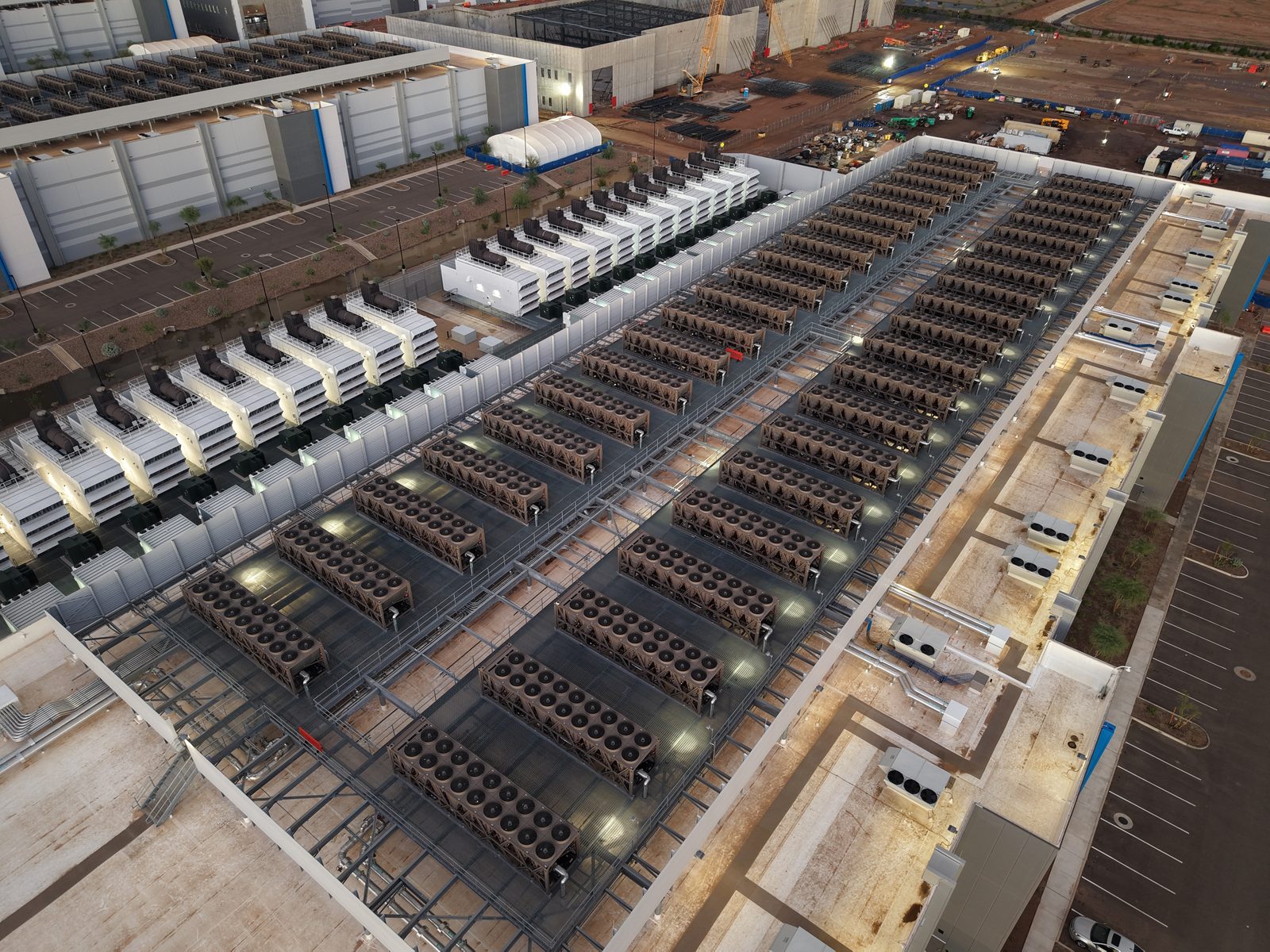
| Google / Columbia County Data Center | White Oak Technology Park, between Appling and Harlem, ~1,900 acres | ~8 million sq ft across 23 buildings (site plans on file; some outlets cite 29 or "up to 33" across White Oak plus Pumpkin Center) | County announced Google as sole end-user and operator on July 23, 2026 (county announcement; Augusta Chronicle). Land disturbance permits filed May 2026, with land-clearing phases estimated to complete in 2027 (Augusta Chronicle, 2026-05-11). In August 2026 the county Economic Development Authority approved a nonbinding agreement with Kinetic Infrastructure Solutions, an Alphabet subsidiary. The binding deal is still being negotiated (Augusta Chronicle, 2026-08-28). Completion anticipated around 2028 (Augusta Business Daily, 2026-09-13). Nothing is built yet. |
| Pumpkin Center ("Project Pumpkin" / "Project Squash") | ~419 acres at Wrightsboro Rd and Appling/Harlem Rd, Greenpoint area | Cloverleaf Infrastructure; phase-1 land disturbance | Bulldozing greenlit (WRDW, ~March 2026). Two outlets, citing the county's deal framing, describe this site as part of the Google MOU footprint; the long-term operator remains unconfirmed. |
| Meta / Sage Mill | Sage Mill Industrial Park near Graniteville, SC (Exit 11, I-20) | $800 million, 715,000 sq ft, AI-optimized; 100% renewable-energy matched, LEED Gold targeted (SC Governor's office, 2024-08-29) | Announced August 2024 as Meta's first South Carolina data center. Under construction. Meta's public policy manager told the SC Senate Judiciary Committee on March 30, 2026: closed-loop liquid cooling, about 1,200 skilled-trade workers at peak construction, about 100 permanent staff, minimal operational cooling water. Expected operational spring 2027 (Aiken County economic-development inventory; Meta, 2026-03-30). |
| QTS Project Eisenhower | 2883 Gordon Hwy, Augusta, next to Haynes Station subdivision | Six two-story buildings, 2.15 million sq ft; $2 billion investment (Augusta Chronicle, 2026-03-27) | Site work underway. First building possibly operational 2027; full buildout takes years (Augusta Chronicle, 2026-03-27). Job figures reported differ by source: about 600 temporary construction jobs (Chronicle, 2026-03-27) vs. about 1,000 over time (WRDW, 2026-05-06); 160 to 200 permanent jobs at roughly $70,000 average salary (Chronicle) vs. 160 to 220 (WRDW). No written jobs commitment has surfaced, so treat all of these as reported, not promised. |
| Project Azalea | 200 acres at Randall Hunt Rd, Thomson, McDuffie County | Up to 6 buildings; about $1 billion in project value per county officials; roughly $25 million in annual local tax revenue at full build-out; about 125 full-time jobs per the DRI assessment; about 400 MW via Jefferson Energy utility; completion targeted 2029 (DRI application, Jan 2026) | Rezoning approved 4-1 by McDuffie County commissioners on March 17, 2026 (Augusta Chronicle, 2026-03-26; WRDW, 2026-03-04; Data Center Dynamics, 2026-03-18). The operator and end user are unknown; do not attribute it to Google or Meta. The CSRA Regional Commission's DRI assessment (finalized 2026-02-13) flagged that sufficient energy supply is not available to serve the project; studies with Georgia Power, Georgia Transmission, and the EMC are ongoing. |
| Oppidan / Graniteville | 13 acres next to Sage Mill Industrial Park, Graniteville, SC | 60,000 sq ft, 15 MW, six full-time employees (Augusta Today, 2025-06-10) | Approved June 2025; developer Clop Aiken SC LLC (Oppidan Investment Co., MN), under a fee-in-lieu-of-taxes agreement. Colliers' Q1 2026 Augusta-Aiken industrial report lists expected delivery in Q4 2026; current construction progress not confirmed in public sources. Separate project from Meta, same industrial corridor. |
| Savannah River Site (DOE) | Aiken County, SC, federal site | DOE's National Nuclear Security Administration selected Amentum on July 20, 2026, to negotiate a phased lease for a 1 GW AI data center with ~2 GW of on-site generation (natural gas first, bridging to advanced nuclear); DC BLOX is a consortium partner (NNSA via legistorm; Amentum and DC BLOX press releases, 2026-07-20) | Lease negotiation phase. Selection is not an award: no final lease, no disclosed financial terms, no timeline (NucNet, 2026-07). Nothing built. |
A few things this table leaves out on purpose. Columbia County rezoned roughly 4,500 additional acres in January 2026 (Byrd Farms, Green Jacket expansion, and the Pumpkin Center site), which is far beyond the Google footprint, so more tenants or developers may arrive; who fills those parcels is unknown. Those are open questions, not facts, and they sit in the unknowns section at the bottom.
Why Georgia, and why here
This is the honest version of "why so many data centers are being built in Georgia," the question people keep typing into Google. A state auditor's review of the industry (Carl Vinson Institute, via The Current, 2026-01-07) and national reporting agree on the main reasons.
Cheap, abundant electricity. This is the strongest draw. The Vinson audit found that electricity makes up about three-quarters of a typical data center's operating costs, and put it plainly: "Cheap electricity is a far stronger draw than tax exemptions." Georgia Power got Public Service Commission approval for roughly 10 GW of new capacity, with about 80% of it slated for current and future data centers (Vinson audit via The Current). That is controversial statewide, but it is also why operators believe Georgia can actually deliver power.
Land, fiber, and low disaster risk. About 70% of Georgia's data-center investment likely would have happened regardless of the tax break, the Vinson audit found, because of fiber infrastructure, low natural-disaster risk, and utility reliability (route-fifty.com, 2026-01-07). Or as a Georgia Tech researcher put it: "land, land, land" in rural Georgia (NPR, 2025-10). The White Oak campus sits on about 1,900 acres of available industrial land, and projects this size need hundreds or thousands of contiguous acres.
Tax incentives, with an asterisk. Georgia has exempted data-center equipment from state and local sales tax since 2018. The Vinson audit found the exemption cost the state at least $1.5 billion since inception, about $500 million in FY2025 alone, and in July 2026 the state Senate voted to suspend it for two years pending a grid-impact study; its status with the governor was unclear as of September 2026 (Bisnow, REPORTED). Counties layer their own tools on top: Columbia County uses a Development Authority bond-for-title structure with Kinetic Infrastructure Solutions, and the Graniteville project got a fee-in-lieu-of-taxes agreement in Aiken County.
A workforce that can build and staff them. Columbia County manager Scott Johnson cited "available land and the ability to train and provide a workforce" as the site choice (Augusta Business Daily, 2026-09-13). General contractors are already holding job fairs for the Google campus, and the county is building a workforce pipeline with Augusta Technical College, local K-12 schools, and Fort Gordon (county statements, July 2026; Google's Jen Ryan at the Future Forward summit in Grovetown, ~Sept 11, 2026, via Augusta Business Daily, 2026-09-13).
Google knows Georgia. Google has operated a data center in Douglas County, its second in North America, since 2003, with more than $3 billion invested statewide (datacenters.google). Big operators prefer places they already know how to permit, staff, and power.
None of this is unique to the CSRA. The same forces are landing data centers across Georgia, from Metro Atlanta to the coast. The difference here is the scale of the county's tax-relief pitch, which is the next section.
The money, and your tax bill
Three numbers keep getting quoted. Here is what each one actually is.
$17 billion. This is the county's working number for total project investment, repeated across county announcements and national outlets. No independently audited construction figure has been published. Treat it as the county's estimate, not a verified spend. When you see it in a headline, read it as "the county says."
$40 million a year for 7 years ($280 million). This is the concrete part. The August 2026 nonbinding agreement has Kinetic Infrastructure Solutions, the Alphabet subsidiary, paying the county $40 million a year for seven years. About $5 million a year stays with the Economic Development Authority; the rest flows to the county general fund and toward homestead property-tax relief (Augusta Today, 2026-08-31). Google would become one of Georgia's largest single taxpayers. The first payments are expected in late 2026 or early 2027, tied to construction milestones.
~$25 million a year. That is roughly what Columbia County currently collects in homestead property taxes. The stated goal, from county commission chairman Doug Duncan, is to use Google's payments to eliminate the county portion of homestead tax bills. Whether the math holds depends on the binding agreement and the referendum below.
The November vote
The legal path to relief runs through HB 439, a new state law effective January 1, 2027, which creates the vessel for homestead grants. Two separate measures sit on the November 3, 2026 ballot. First, the local HB 439 authorization for Columbia County, which is confirmed as scheduled: county manager Scott Johnson urged voters to take part in the November ballot tied to HB 439, explaining the bond-for-title mechanism (County Compass podcast, 2026-07-05). If voters approve, Google's revenues can be directed to homestead tax relief; if not, the county still collects the money but cannot use it for direct relief. Second, a statewide constitutional amendment that would expand the homestead exemption, phasing up from 2027 onward (reported via county staff legislative briefings, 2026-06-04; the exact ballot language was not publicly verified as of September 2026). One outlet reported that without the amendment, relief would be capped per household; treat the specific cap figure as reported, not confirmed, until the ballot language is published. The county's board directed the elections office to place the measure on the ballot in July 2026 (citizen portal summaries of public meetings), and the county has set aside about $8.6 million toward a Homestead Tax Relief Grant Fund (Aug 2026 BOC meeting).
This page explains the ballot measures factually and does not cover candidates or campaigns. Commission races on the same ballot have featured data-center debate, but that is election coverage, and it is not what this page is for.
The honest caveats
The payments run seven years. The buildings are permanent. Whether the relief outlasts the deal depends on the binding agreement's full term and any renewal, and that is unknowable until the document is public. Meanwhile, county assessments have been rising fast enough that some homeowners report $20,000 to $80,000 jumps, which could swallow the relief on paper. If you own a home in Columbia County, the November referendum is the vote that touches your wallet. Read the ballot language when it is published and decide for yourself.
Jobs, honestly
Data centers are famously light on permanent staff. The employment story has two chapters, and only one of them is large.
Construction is the real jobs story. Building these campuses takes years and hundreds to low thousands of skilled-trades jobs. Meta reports about 1,200 skilled-trade workers at peak construction for its Aiken facility (Meta public policy manager Alicia Treanor to the SC Senate Judiciary Committee, 2026-03-30). QTS figures differ by source: about 600 temporary construction jobs (Augusta Chronicle, 2026-03-27) vs. about 1,000 over time (WRDW, 2026-05-06); no written commitment has surfaced, so neither is a promise. Google's general contractors are already holding job fairs and seeking local vendors, with the workforce pipeline through Augusta Technical College, local schools, and Fort Gordon. If you are a tradesperson, this is your window, and it runs roughly 2026 through 2028.
Permanent operations run in the hundreds, not the thousands. The reference points:
- Meta expects about 100 permanent staff at its Aiken facility (Meta, 2026-03-30).
- QTS expects 160 to 200 permanent jobs at Eisenhower at an average salary around $70,000 (Augusta Chronicle, 2026-03-27), or 160 to 220 per WRDW's May 2026 report. Again, reported, not committed.
- Project Azalea's DRI assessment models about 125 full-time jobs (2026-02-13).
- The county-commissioned Columbia County study models about 1,667 direct operational jobs at a full 15-million-sq-ft build-out, with $138.9 million in annual pay and benefits (Columbia County Observer study document). Read that number with care: it is the county's own consultant's modeled maximum, not a guarantee, and the study models a larger build-out than the current White Oak plans.
- Brookings (August 2026), studying 93 counties and 770 facilities, found a typical county gains about 100 to 200 data-processing and telecom jobs in the decade after its first large data center, with wages unchanged and home prices up 2 to 5 percent (brookings.edu).
- A Governing analysis of the state auditor's numbers put Georgia's data-center tax breaks at $474 million in a single year, working out to nearly $289,000 in exemptions per permanent job the state could actually count, after the audit was revised down (Governing, 2026-06-24, reported with attribution).
The bottom line: the payoff is construction jobs plus a bigger commercial tax base, not a hiring boom. Anyone implying otherwise is selling something. That framing comes straight from the evidence, and it is the same conclusion Wednesday's issue reached.
Power and water
These are the two questions residents ask most, and the two where the details matter.
Will my power bill go up? The county's answer, via Georgia Power's Customer Protection Pledge, is that rates stay steady through 2028, with typical residential savings of more than $100 a year anticipated afterward. Google has committed to paying 100% of all energy costs tied to the project (county news release, 2026-07-23). The county's December 2025 data center ordinance also requires the developer to pay for all grid upgrades the project needs. Federally, the Trump administration's voluntary "Ratepayer Protection Pledge," unveiled in July 2026 with Columbia County leaders present in Washington, asks large operators to fund the generation and grid upgrades their facilities require rather than shifting costs to ratepayers.
The honest version: the pledge covers the campus's own consumption and the upgrades it needs. What happens to rates after 2028 is the live question, and a state senator's bill (SB 34, Feb 2025) to bar the PSC from raising rates to cover data-center costs is opposed by Georgia Power (Georgia Recorder, 2026-02-10). Watch that space.
One wrinkle worth knowing: the White Oak campus's actual power demand has never been disclosed publicly. A resident claimed "a gigawatt" at an October 2025 meeting, but that is unverified. Treat any megawatt figure for the Google campus as unknown.
What about water? This is the top community concern, and the county knows it. The December 2025 ordinance bans aquifer wells, requires closed-loop cooling, caps noise at 65 decibels at the property line, and sets 500-foot buffers where the campus meets homes or farmland. The county has said the developer pays for roughly $80 million in water system work (county-cited figure, 2025). QTS has used closed-loop cooling since 2018 and reports about 18,000 gallons per building per day for sanitary use only (QTS, May 2026).
A detail that shows how real the water question is: Augusta Utilities is exploring routing treated wastewater to the QTS site for cooling, partly because the city is nearing its Clean Water Act discharge cap (WRDW, 2026-05-11). The engineering is solvable. The trust is the harder part: residents remember the early days, when quiet land deals and nondisclosure agreements damaged confidence, and the county manager has since acknowledged the process started too quietly.
THINKING ABOUT MOVING HERE?
Get the CSRA in your inbox before you move.
Local news, useful numbers, and town-by-town context. Three mornings a week.
Free to read. Easy to leave. Opens Beehiiv in a new tab.
What it means for home values and the cost of living
There is no CSRA-specific housing study on this, so this section is watch items, not conclusions.
- Rentals near construction zones. A multi-year build employing hundreds to low thousands of trades workers tightens rentals around Appling, Harlem, and Grovetown during 2026 to 2028. The county's own economic study notes induced spending on hotels, apartments, restaurants, groceries, and gas. If you are renting in those areas, renewals in that window are the thing to watch.
- Assessments vs. relief. If the November referendum passes, homeowner carrying costs fall on the county portion of the bill. But rising assessments (residents report $20,000 to $80,000 jumps) can swallow the relief. Both dynamics deserve a line in your own math.
- Homes right next door. Greenpoint residents near the Pumpkin Center site bought expecting the originally planned retail and restaurants; now they face a data center next door. Proximity to industrial campuses is not neutral for resale, and the county's 500-foot buffers and 12-foot berms are designed to blunt that, not erase it.
- The tax comparison. The relief conversation is inseparable from which county you live in. Evans vs Augusta lays out how Columbia and Richmond counties' taxes and costs actually compare, and it is the right companion read if you are deciding where to buy. If safety is also on your checklist, Is Augusta, GA safe? is the honest version of that question. For the broader picture of day-to-day costs, our cost-of-living guide arrives October 7.
The permanent workforce is modest (section 4), which is why this story is unlikely to move the housing market on its own. The construction window is the period to watch.
What people are worried about
Drawn from commission meetings, the county's July 2026 announcement threads, and local news comments. The tone is sharply polarized: supporters cite jobs and tax relief; opponents cite resources and distrust. What follows represents the mainstream concerns, not the fringe.
- Water. The number one worry: aquifer depletion in rural Appling and Harlem, and whether closed-loop cooling and the no-wells rule perform as promised.
- Power bills after 2028. Skepticism that the rate pledge holds once it expires, fed by rising-bill anecdotes.
- Noise. The 65-decibel limit, diesel backup generators, and low-frequency hum near homes; Greenpoint and Pumpkin Center residents fear 24/7 operational noise.
- Property values. See section 6. Residents who bought near planned retail now border industrial sites.
- Transparency. The early NDAs and quiet land assembly damaged trust. "You hid behind NDAs," a resident told the commission in February 2026, and the county manager has since acknowledged it.
- Enforcement. "When they break the rules, are they just fined, or shut down?" Residents want penalties with teeth, not just covenants on paper.
- Jobs skepticism. "Data centers don't really bring jobs." Section 4 is the honest answer to this one.
- Tax-relief skepticism. "I'll bet your property taxes don't go anywhere." The seven-year deal vs. permanent impacts, in one sentence.
Two things to keep separate. Claims about health effects from data-center EMF show up in comment threads, but no evidence has been presented; this page does not treat them as credible. And the September 2026 lawsuit by Georgia families against Meta over water contamination is real news, but it is a different company in a different county (Morgan County); it is regional context, not evidence about the CSRA projects.
What is still unknown
An honest explainer ends with the open questions:
- The final binding agreement terms between Columbia County and Google, beyond the nonbinding MOU. No change as of late September 2026.
- How much power the White Oak campus will actually draw. Never disclosed publicly.
- The final building count (sources say 23, 29, or up to 33) and who ends up operating the Pumpkin Center site long term.
- Verified capital expenditure. The $17 billion figure is the county's working number, not audited spend.
- Whether the November referendum passes, and what the final ballot language says about the statewide amendment's mechanics.
- The operator and end user of Project Azalea, and whether its power-supply question gets resolved.
- Whether Meta's Aiken facility holds its spring 2027 operational target, and the current construction state of the Oppidan/Graniteville project.
- Whether the full energy-cost commitment covers long-term transmission upgrades or just the campus's own consumption.
- Details on who fills the additional ~4,500 acres Columbia County rezoned in January 2026, and the outcome of the Savannah River Site lease negotiation.
- The final adoption status of Augusta's data center ordinance (public hearings were held in July 2026; final status unverified as of September 2026).
- The Georgia Court of Appeals ruling on the Guido petitions challenging the rezonings (appeals filed April 16, 2026).
FAQ
Is there a data center coming to Augusta, GA?
Yes, more than one, and two of the biggest names in tech. Google is the named end-user and operator of the roughly 8-million-sq-ft campus at White Oak Technology Park between Appling and Harlem in Columbia County, announced July 23, 2026 (county announcement; Augusta Chronicle). Meta is building its first South Carolina data center at Sage Mill Industrial Park near Graniteville: an $800 million, 715,000-sq-ft AI facility, under construction, targeting spring 2027 operations (SC Governor's office, 2024-08-29; Meta to the SC Senate Judiciary Committee, 2026-03-30). QTS is building Project Eisenhower at 2883 Gordon Hwy in Augusta, six buildings totaling 2.15 million sq ft (Augusta Chronicle, 2026-03-27). Project Azalea is approved for 200 acres in Thomson, McDuffie County, with up to six buildings and about 125 projected jobs; its operator is unknown (Augusta Chronicle, 2026-03-26). A smaller 60,000-sq-ft site was approved in Graniteville in June 2025 (Augusta Today). The Department of Energy is negotiating a phased lease for an AI data center at the Savannah River Site with the Amentum and DC BLOX consortium (NNSA, 2026-07-20). None are operating yet.
Why are so many data centers being built in Georgia?
The short version, from a state auditor's review (Carl Vinson Institute, via The Current, 2026-01-07): cheap electricity is the strongest draw, making up about three-quarters of a typical facility's operating costs, ahead of tax breaks. Georgia offers land at scale ("land, land, land," in one researcher's phrasing, NPR, 2025-10), fiber infrastructure, low natural-disaster risk, and utility reliability. There are tax incentives too, a state and local sales-tax exemption on data-center equipment since 2018, though the state Senate voted in July 2026 to suspend it for two years pending a grid-impact study. And Google has two decades of operating experience in the state since its Douglas County facility opened in 2003. The national driver is AI and cloud demand.
Will the data centers raise my power bill?
Under the current commitments, no, through 2028. Georgia Power's Customer Protection Pledge (via the county) holds rates steady through 2028, with typical residential savings of more than $100 a year anticipated afterward, and Google has committed to pay 100% of the project's energy costs (county news release, 2026-07-23). The county ordinance also makes the developer pay for required grid upgrades. After 2028 is the open question; watch the PSC and SB 34.
Will I get a property tax break?
Possibly, if you own a homestead in Columbia County and the November 3, 2026 referendum passes. The local HB 439 authorization would enable the county to direct Google's $40-million-a-year payments toward eliminating the county portion of homestead tax bills, with relief potentially landing on 2027 bills (HB 439, effective Jan 1, 2027). A separate statewide constitutional amendment on the same ballot would expand the homestead exemption further; the exact mechanics depend on the published ballot language. Assessments rising $20,000 to $80,000 could offset the relief, and the payments run seven years while the buildings are permanent.
How many jobs will the data centers create?
Construction first: hundreds to low thousands of skilled-trades jobs over a multi-year build (Meta reports about 1,200 at peak in Aiken; QTS figures range from 600 to about 1,000 depending on the source; Google's contractors are already holding job fairs). Permanent operations: hundreds, not thousands. Meta expects about 100 permanent staff in Aiken (Meta, 2026-03-30). QTS expects 160 to 200 permanent jobs at an average salary around $70,000 (Augusta Chronicle, 2026-03-27). Project Azalea's assessment models about 125 full-time jobs. The county's own study models about 1,667 direct operational jobs at a full 15-million-sq-ft build-out (an optimistic modeled maximum); Brookings found typical counties gain 100 to 200 data-processing and telecom jobs in the decade after their first large data center.
Is the $17 billion figure real?
It is the county's working number for total project investment, repeated across county announcements and national outlets. No independently audited construction figure has been published, so treat it as the county's estimate rather than a verified spend. The concrete, contracted figure is the $40 million a year for seven years in the current agreement.
Sources: Augusta Chronicle (2026-07-23; 2026-07-29; 2026-08-28; 2026-03-27; 2026-03-26; 2026-05-11); Augusta Today (2026-08-31; 2025-06-10); Augusta Business Daily (2026-09-13); Hot Augusta (2026-07-27); Data Center Dynamics (2026-09-17; 2026-07-22; 2026-03-18); WRDW/WAGT (2026-07-25; ~2026-03; 2026-05-11; 2026-05-28; 2026-05-06; 2026-03-04; 2026-06-22); SC Governor's office (2024-08-29); Meta public policy testimony, SC Senate Judiciary Committee (2026-03-30); NNSA/Amentum/DC BLOX announcements (2026-07-20); NucNet (2026-07); CSRA Regional Commission DRI assessment (2026-02-13); Columbia County BOC public meetings and Economic Development Authority announcements (2025-2026); Columbia County data center district ordinance (Dec 2025); Columbia County Observer economic impact study; Georgia Power 2025 Integrated Resource Plan; GA PSC testimony (Jan 2026); Georgia Recorder (2026-02-10); legis.ga.gov (HB 439 text); Carl Vinson Institute audit via The Current and route-fifty (2026-01-07); Brookings (2026-08); Governing (2026-06-24); NPR (2025-10); datacenters.google; Colliers Q1 2026 Augusta-Aiken Industrial Report; citizen portal summaries of public meetings (treated as secondary). Social and comment threads sampled September 2026 for community concerns only, never for facts.
KEEP THIS GUIDE USEFUL
Data center facts move fast: agreements get signed, referendums pass or fail, and construction schedules change. Verify time-sensitive details before acting, and send corrections when you find something newer.